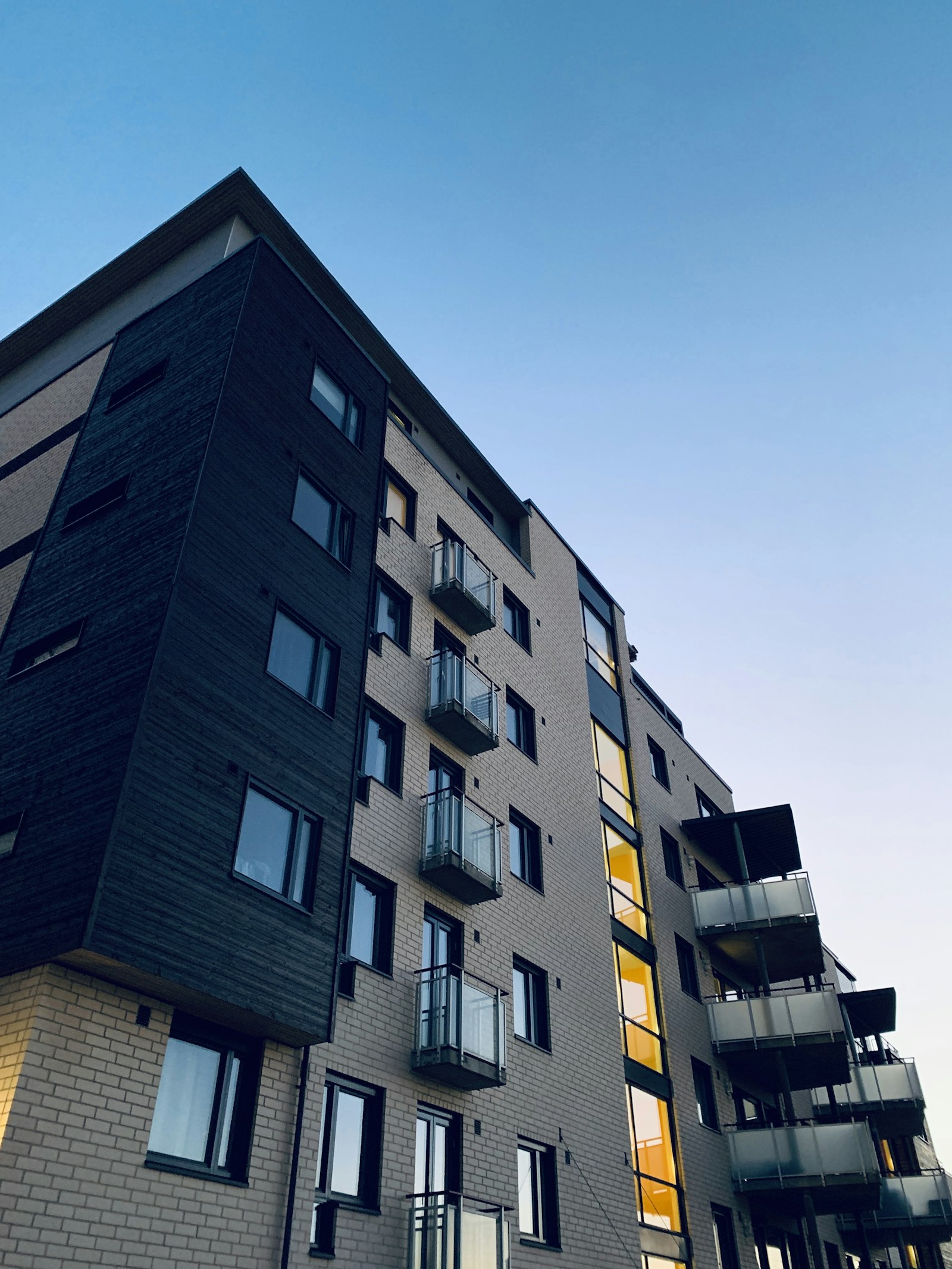
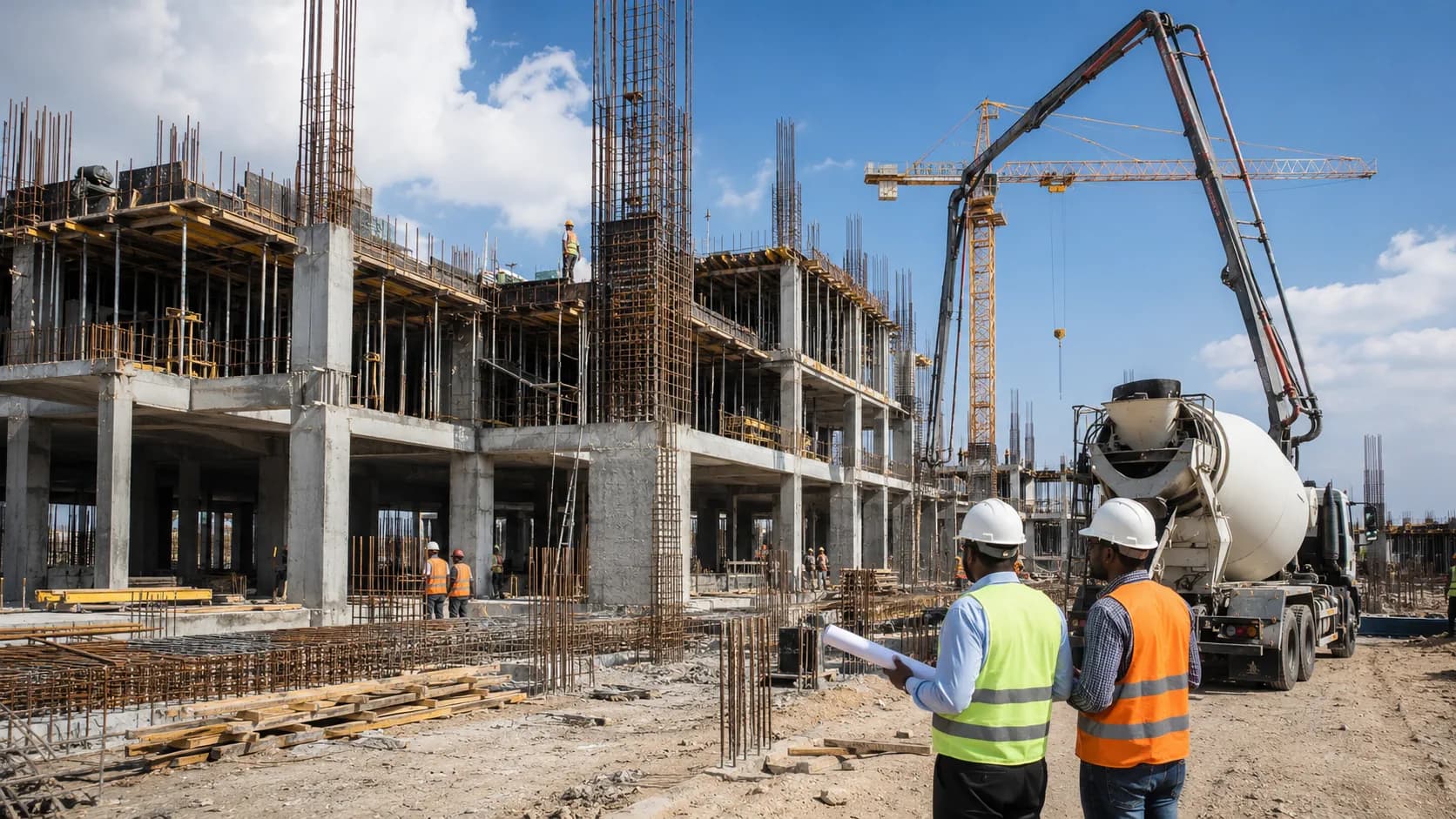
Apartment building construction in Dar es Salaam is booming, and getting the concrete specification right is critical to the safety, durability, and cost-effectiveness of your project. This guide covers everything you need to know about choosing and using ready-mix concrete for multi-storey residential buildings.
Recommended Concrete Grades for Apartment Buildings
The concrete grade required for an apartment building depends on the number of storeys, the structural design, and soil conditions. Most apartment buildings in Dar es Salaam use a combination of C25 and C30 concrete:
| Building Element | Recommended Grade | Reason |
|---|---|---|
| Blinding / leveling | C10 – C15 | Non-structural, cost-effective fill |
| Strip foundations | C25 | Standard for low-rise (up to 2 storeys) |
| Raft foundations | C30 – C35 | High load-bearing for multi-storey |
| Columns (low-rise) | C25 – C30 | Vertical load support up to 4 storeys |
| Columns (mid/high-rise) | C30 – C40 | Higher compressive strength needed |
| Suspended slabs | C30 | Span between floors, vehicle loads |
| Shear walls | C30 – C35 | Lateral stability against wind/seismic |
| Staircases | C25 | Moderate strength, wear resistance |
Foundation Requirements
The foundation is the most critical concrete element in any apartment building. In Dar es Salaam, soil conditions vary significantly between areas. Coastal areas with sandy soil may require deeper foundations or pile systems, while areas with clay soil need careful drainage and reinforcement design.
For apartment buildings above two storeys, a raft foundation or pile foundation is typically required. Raft foundations distribute the building load over a wide area and are suitable for moderately stable soils. Pile foundations transfer loads to deeper, more stable soil layers and are used in areas with poor surface soil conditions.
The concrete used in foundations should typically be C30 or higher to withstand the compressive forces from the structure above. Your structural engineer will specify the exact grade based on load calculations and soil test results.
Read our complete foundation concrete guide →
Column and Slab Specifications
Columns and suspended slabs are the primary structural elements that determine the building's strength and stability. Key considerations include:
Columns
Columns carry the vertical load from upper floors down to the foundation. For a 4-storey apartment building, ground floor columns typically need C30 concrete, while upper-floor columns may use C25. Column dimensions and reinforcement spacing must follow the structural engineer's design.
Suspended Slabs
Slabs spanning between floors require C30 concrete for adequate strength and deflection control. Slab thickness typically ranges from 125 mm to 200 mm depending on the span and loading. Proper curing is essential to prevent cracking and ensure long-term durability.
Shear Walls
Shear walls provide lateral stability against wind loads. In multi-storey apartment buildings, shear walls are typically constructed with C30 or C35 concrete and extend from the foundation to the roof level.
Quantity Estimation
Estimating concrete quantities accurately is crucial for budgeting and ordering. Here are rough guidelines for apartment building elements:
- Raft foundation: 0.3 – 0.5 m³ per m² of building footprint
- Columns: 0.02 – 0.04 m³ per m² of floor area per storey
- Suspended slabs: 0.12 – 0.18 m³ per m² of floor area
- Shear walls: 0.05 – 0.10 m³ per m² of wall area
- Staircases: 0.5 – 1.0 m³ per flight
For a typical 4-storey apartment building with a 200 m² footprint, total concrete volume typically ranges from 200 to 350 m³, depending on the design. Your quantity surveyor or engineer can provide a precise estimate.
Delivery Planning for Apartment Projects
Large apartment projects require careful delivery planning to ensure a smooth pour. Key considerations:
- Schedule in advance — Book your concrete delivery at least 48–72 hours ahead. For large pours, give 5–7 days notice.
- Plan pump access — Ensure the pump truck has clear access to the pour area. For upper floors, confirm the boom pump can reach the required height and distance.
- Coordinate with labour — Have enough workers on site to handle the concrete as it arrives. A typical crew for a pump pour is 4–6 workers plus a supervisor.
- Prepare for continuous pour — Large structural elements like raft foundations and slabs should be poured continuously to avoid cold joints. Plan truck arrival intervals accordingly.
- Have a backup plan — Weather, traffic, and equipment issues can cause delays. Have a contingency plan for protecting fresh concrete in case of unexpected rain or interruptions.
Concrete Quality Control
For apartment buildings, concrete quality control is non-negotiable. Every load should be tested for:
- Slump test — Measures workability. Target slump for pumped concrete is typically 75–125 mm.
- Temperature — Fresh concrete temperature should be between 10°C and 30°C for optimal curing.
- Compressive strength tests — Cubes should be taken from each day's pour and tested at 7 and 28 days.
- Visual inspection — Check for segregation, excessive bleeding, or contamination in each truck load.
Tanzibaba provides quality test certificates with every delivery, giving you full traceability and peace of mind. Order ready-mix concrete for your apartment project →
Building an Apartment in Dar es Salaam?
We supply premium ready-mix concrete for apartment projects of all sizes. Get an instant quote or speak with our team for expert advice on concrete grades and quantities.