
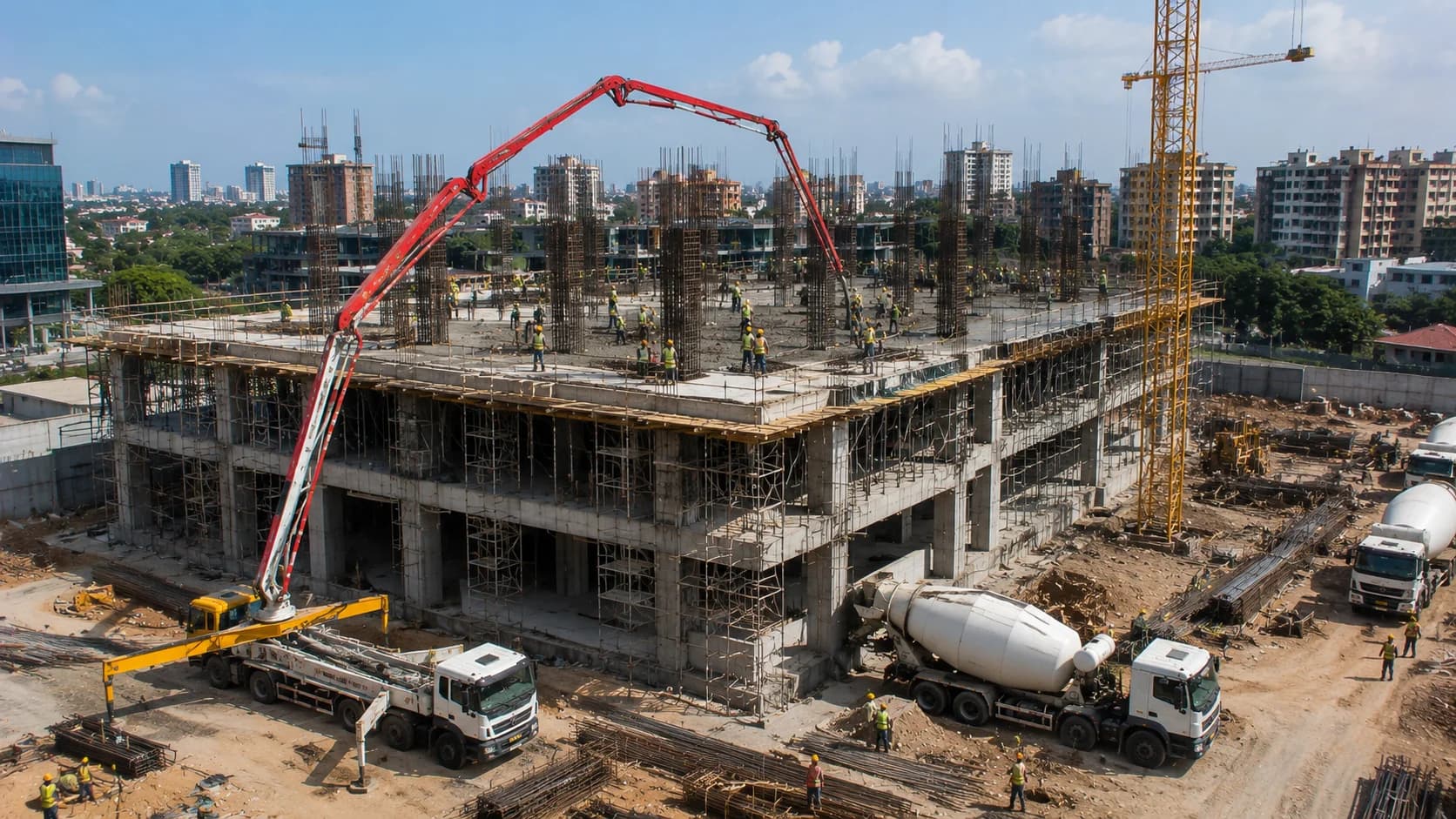
A concrete pump can be the difference between a smooth, efficient pour and a slow, labour-intensive day on site. But not every project needs one. This guide explains the types of concrete pumps available in Dar es Salaam, when you need one, how much it costs, and the key benefits.
What Is a Concrete Pump?
A concrete pump is a machine that transfers liquid concrete from the mixer truck to the point of placement using a system of pipes and hoses. Instead of manually wheeling concrete in barrows or using a crane and skip, a pump delivers concrete precisely where it is needed — even if that is several floors up or hundreds of metres away from the truck.
Types of Concrete Pumps
There are two main types of concrete pumps used in Dar es Salaam:
Line Pump (Trailer-Mounted)
A line pump is mounted on a trailer and uses flexible hoses to move concrete. It is the most common pump for residential and medium-scale projects.
- Lower cost than boom pumps
- Can reach up to 150 metres horizontally
- Requires manual hose guidance
- Ideal for ground slabs and low-rise buildings
Boom Pump (Truck-Mounted)
A boom pump is mounted on a truck with a robotic arm (boom) that can be positioned precisely over the pour area. It is used for large-scale and multi-storey projects.
- Hydraulic boom reaches up to 50+ metres vertically
- Requires fewer workers to operate
- Higher rental cost
- Ideal for high-rise buildings and large pours
When Do You Need a Concrete Pump?
While concrete can be placed manually using wheelbarrows and chutes, a pump becomes necessary in certain situations:
Multi-Storey Construction
For upper-floor slabs and columns, a pump is the only practical way to deliver concrete. Carrying concrete up stairs or scaffolding is slow, unsafe, and risks the concrete setting before placement.
Difficult Site Access
If the mixer truck cannot park close to the pour area — due to narrow roads, gates, or terrain — a pump with long hoses can bridge the gap.
Large Volume Pours
For pours exceeding 10 m³, a pump significantly speeds up placement. This reduces the risk of cold joints and ensures uniform concrete quality across the entire pour.
Concrete Pump Costs in Dar es Salaam
Concrete pump rental in Dar es Salaam typically costs:
- Base call-out fee: TZS 100,000 – 150,000 (covers mobilisation and setup)
- Per-cubic-metre charge: TZS 4,000 – 6,000 / m³ pumped
- Minimum charge: Most suppliers require a minimum volume of 5–8 m³ for pump service
For a typical 10 m³ residential slab pour, pump service adds approximately TZS 200,000 to your total cost. For larger commercial pours of 50 m³, the pump cost averages around TZS 400,000.
While this is a significant expense, the time savings, reduced labour costs, and improved concrete quality often justify the investment. Many contractors find that a pump pays for itself by reducing pour time from hours to minutes.
View Tanzibaba concrete pump rental services →
Benefits of Using a Concrete Pump
Faster Placement
A pump can place 20–40 m³ of concrete per hour, compared to 5–10 m³ per hour with manual methods. Your pour finishes faster, reducing labour costs and overtime.
Better Concrete Quality
Faster placement means the concrete is still fresh and workable when it reaches the formwork. This reduces the risk of cold joints, segregation, and strength loss.
Reduced Labour
A pump replaces a team of workers who would otherwise be pushing wheelbarrows. Fewer people on site means lower labour costs and improved safety.
Precise Placement
The pump hose delivers concrete exactly where you need it — into deep foundation trenches, between rebar cages, or onto upper-floor slabs — with minimal waste.
Tips for Using a Concrete Pump
- Plan your pump position — Ensure there is clear access for both the mixer truck and the pump vehicle. The pump should be on stable, level ground.
- Prime the pump — The pump should be primed with a grout slurry before concrete starts flowing to lubricate the pipes.
- Maintain concrete consistency — The concrete mix should have adequate workability (slump of 75–125 mm) for pumping. Very stiff mixes may block the pipes.
- Communicate clearly — Have a worker with a radio or phone at the pour area to signal the pump operator when to start, stop, or adjust flow.
- Clean the pump immediately — After the pour, the pump and pipes must be flushed with water and cleaned to prevent concrete from hardening inside.
Need a Concrete Pump for Your Project?
Tanzibaba offers professional concrete pump services across Dar es Salaam. Whether you need a line pump for a ground slab or a boom pump for a high-rise, we have the equipment and expertise.