
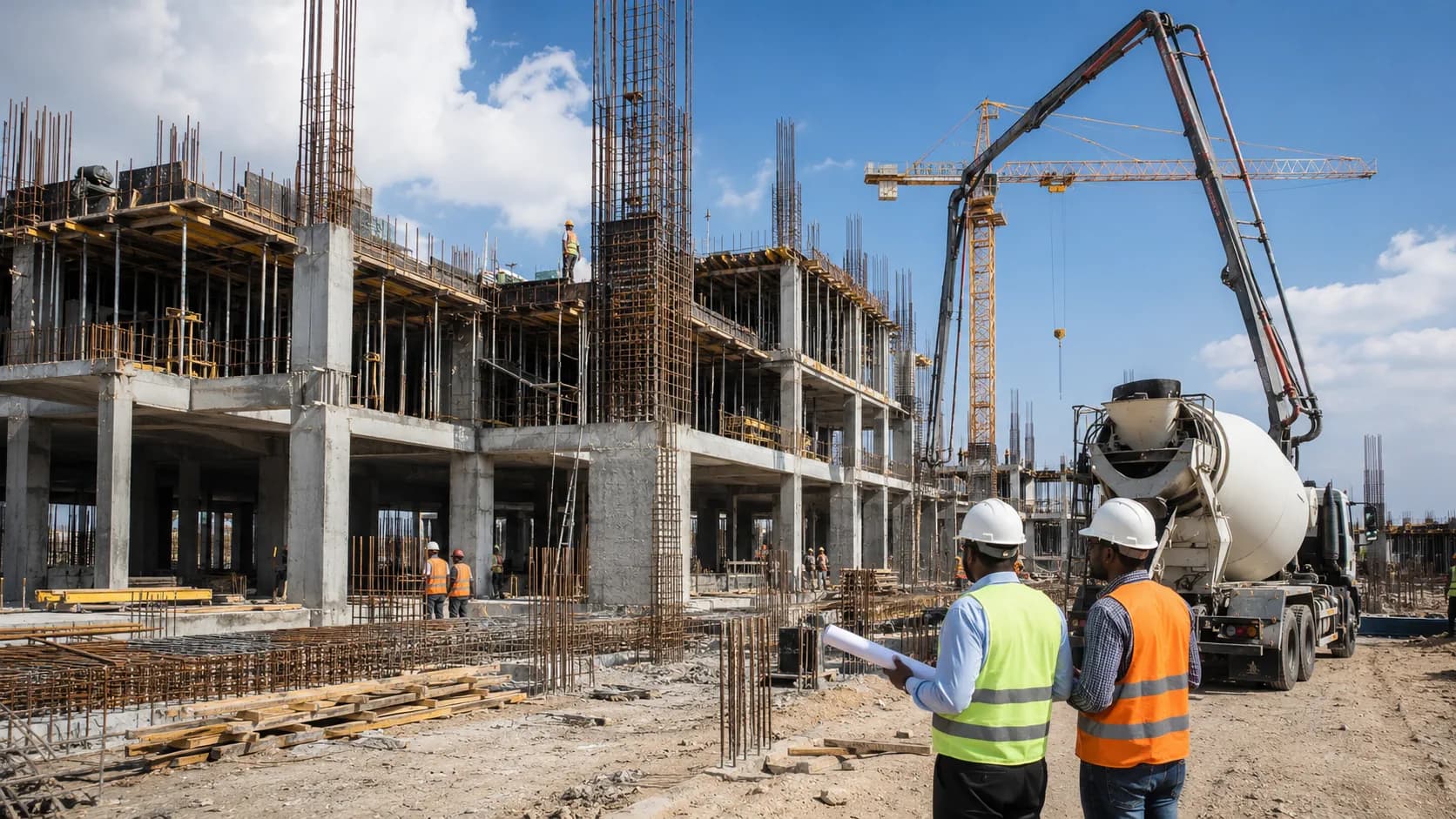
The foundation is the most important part of any building. Getting the concrete mix right ensures your structure stands strong for decades. This guide covers foundation types, recommended concrete grades, curing best practices, common mistakes, and tips for ordering concrete for foundation work in Dar es Salaam.
Types of Foundations
The type of foundation you need depends on the soil conditions, building load, and local building codes. In Dar es Salaam, the most common foundation types are:
Strip Foundation
A continuous strip of concrete that supports load-bearing walls. The most common and economical foundation for single-storey houses.
Best for: Single-storey houses on stable soil
Typical grade: C25
Raft Foundation
A thick concrete slab that covers the entire building footprint, distributing the load over a wide area. Used for multi-storey buildings and poor soil conditions.
Best for: Multi-storey buildings, unstable soil
Typical grade: C30 – C35
Pile Foundation
Deep concrete columns (piles) driven into the ground to reach stable soil layers. Piles transfer building loads to deeper, stronger ground.
Best for: Weak surface soil, high-rise buildings
Typical grade: C30 – C40
Recommended Concrete Grades for Foundations
Choosing the right concrete grade for your foundation is critical. Here are the recommended grades based on foundation type and building size:
| Foundation Type | Building Height | Recommended Grade |
|---|---|---|
| Strip foundation | Single storey | C25 |
| Strip foundation | Two storeys | C25 – C30 |
| Raft foundation | 2–4 storeys | C30 – C35 |
| Raft foundation | 5+ storeys | C35 – C40 |
| Pile foundation | Any | C30 – C40 |
| Pad foundation | Single storey | C25 |
Concrete Mix Design for Foundations
Foundation concrete must be designed to withstand both compressive forces from the building above and environmental factors like moisture and soil chemicals. Key mix design considerations include:
- Cement content — Foundation concrete typically requires 350–420 kg/m³ of cement depending on the grade. Higher cement content increases strength and durability.
- Water-cement ratio — A low water-cement ratio (0.45–0.55) produces stronger, more durable concrete. Excess water weakens the concrete and increases shrinkage cracking.
- Aggregate size — For foundation work, 20 mm or 40 mm coarse aggregate is typically used. Larger aggregates reduce the cement paste required and help control heat generation in thick sections.
- Workability — Foundation concrete should have a slump of 50–100 mm for trench fill and 75–125 mm if a pump is being used.
Tanzibaba uses advanced washed sand technology that removes silt and clay from the aggregate, producing cleaner concrete with superior bond strength. This is especially important for foundations where long-term durability is critical. Order ready-mix concrete for your foundation →
Curing Foundation Concrete
Proper curing is essential for foundation concrete to achieve its design strength and durability. In Dar es Salaam's warm climate, curing requires special attention:
Keep Concrete Moist
Foundation concrete should be kept continuously moist for at least 7 days after pouring. In hot weather, extend this to 10–14 days. Use wet burlap, plastic sheeting, or a water spray to prevent moisture loss.
Protect from Heat
In Dar es Salaam's heat, fresh concrete can lose moisture rapidly, leading to plastic shrinkage cracks. Pour early in the morning or late afternoon when temperatures are lower. Have curing materials ready before the concrete arrives.
Control Joints
For large foundation slabs, install control joints (also called contraction joints) to manage cracking. These joints should be cut or formed at intervals of 3–5 metres, depending on slab thickness and reinforcement.
Common Foundation Concrete Mistakes
Avoid these frequent errors that compromise foundation quality:
Using the Wrong Grade
Using C20 concrete for a foundation that requires C25 or C30 is a common cost-cutting mistake. The savings are minor compared to the risk of structural failure. Always follow your engineer's specification.
Adding Water on Site
Adding water to ready-mix concrete on site to improve workability is one of the worst mistakes you can make. It increases the water-cement ratio, which significantly reduces strength and durability. If the concrete is too stiff, request a mix redesign from your supplier.
Poor Compaction
Inadequate vibration or tamping leaves air pockets (honeycombing) in the concrete, reducing strength and exposing reinforcement to moisture. Use a poker vibrator for deep sections and ensure proper compaction around rebar and corners.
Insufficient Curing
Many builders underestimate the importance of curing. Concrete that is not properly cured can lose 30–50% of its potential strength. In Dar es Salaam's climate, curing is even more critical due to high evaporation rates.
Pouring on Dry or Dirty Soil
Pouring concrete onto dry soil causes the soil to absorb water from the concrete, weakening the mix. Always dampen the soil before pouring. Also ensure the excavation is clean — loose soil, debris, and standing water must be removed.
Tips for Ordering Foundation Concrete
- Order 10–15% extra — Account for wastage, uneven ground, and over-excavation. It is better to have a small surplus than to run short and create a cold joint.
- Specify the correct grade — Clearly state the concrete grade required (e.g., C25 for strip foundations, C30 for raft foundations).
- Arrange pump access — For deep trench foundations or large raft slabs, a concrete pump may be necessary. Confirm pump requirements when ordering.
- Schedule delivery timing — Foundation pours should be continuous to avoid cold joints. Coordinate truck arrival intervals based on your pour rate and crew size.
- Request test cubes — Ask your supplier for compressive strength test cubes from each delivery day. This provides documentation of concrete quality for your records and building inspector.
Building a Foundation in Dar es Salaam?
Get the right concrete for your foundation from Tanzibaba. Premium quality, correct grades, and reliable delivery. Get an instant quote or speak with our team.