
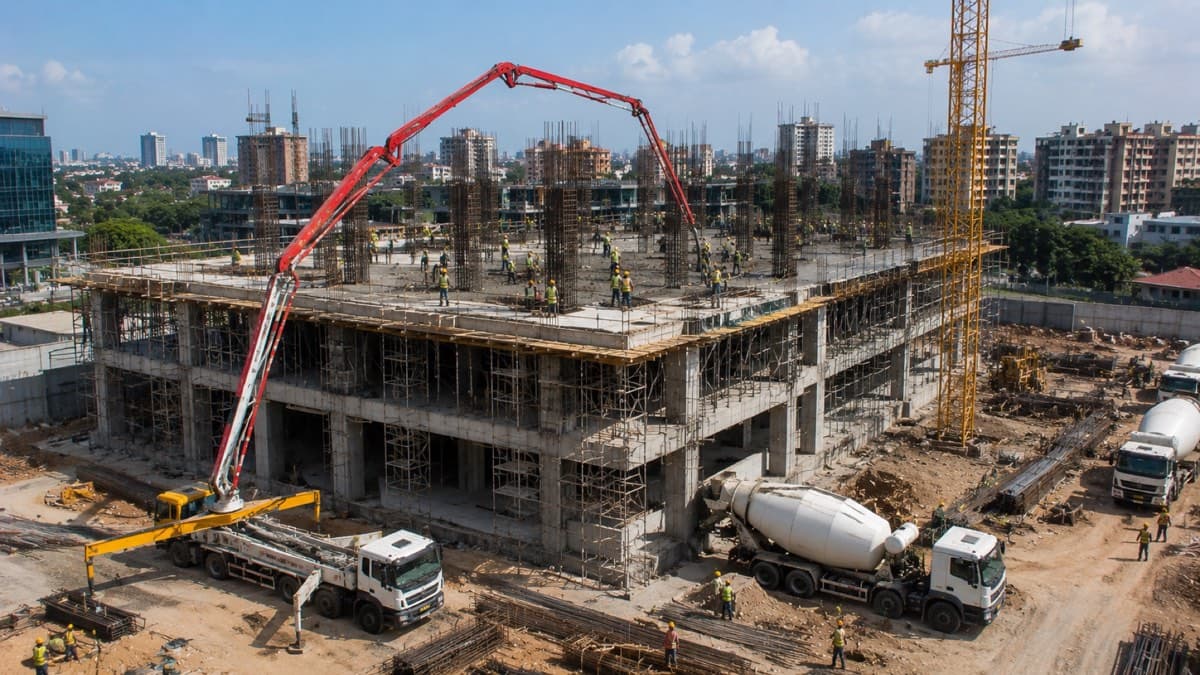
Understanding how concrete is delivered helps you plan your project, avoid costly delays, and ensure your pour goes smoothly. From the batching plant to the final placement, every step matters. This guide walks you through the complete ready-mix concrete delivery process in Dar es Salaam, so you know exactly what to expect on delivery day.
How Ready-Mix Concrete Is Delivered
Ready-mix concrete delivery is a carefully coordinated process that begins at a batching plant and ends at your project site. Unlike mixing concrete on site — which introduces variability in quality and consistency — ready-mix is produced under controlled conditions and delivered fresh in specialised mixer trucks. In Dar es Salaam, most residential and commercial projects rely on ready-mix delivery because it saves time, ensures consistent quality, and reduces labour requirements.
The journey from plant to pour involves four main stages: production at the batching facility, transport in a mixer truck, on-site delivery setup, and the actual pouring and placing of concrete. Each stage has its own requirements and best practices that every builder and homeowner should understand.
Step 1 — Production at the Batching Facility
Every delivery starts at a concrete batching plant. Here, raw materials — cement, sand, coarse aggregate, and water — are precisely measured and mixed according to the specified concrete grade. In Dar es Salaam, plants like Tanzibaba's use computer-controlled batching systems to ensure every cubic metre meets the required strength and workability standards.
Before the concrete is loaded into the mixer truck, quality control tests are performed. A slump test measures workability, and cubes may be sampled for compressive strength testing at 7 and 28 days. The water-cement ratio is verified to ensure it matches the design mix. Only once the batch passes inspection is it released for delivery. This quality assurance is one of the main advantages of ready-mix over site-mixed concrete.
Step 2 — Transport in Mixer Trucks
The fresh concrete is loaded into the drum of a concrete mixer truck. The drum continuously rotates during transport — typically at 2–6 revolutions per minute — to keep the concrete agitated and prevent it from setting. This rotation maintains the concrete in a plastic, workable state until it reaches your site.
Mixer trucks in Dar es Salaam typically carry 5 to 7 cubic metres per load. The drum is watertight and equipped with internal mixing blades that ensure the concrete remains homogenous during transit. Drivers are trained to add water only within strict specifications if needed to adjust slump on arrival. The standard delivery time window from batching to placement is 60 to 90 minutes, though this can be extended with the use of retarder admixtures.
Traffic in Dar es Salaam is a real factor in delivery planning. Reputable suppliers schedule deliveries during off-peak hours — typically early morning or late afternoon — and maintain real-time communication with drivers to anticipate delays. If a truck is held up, the drum speed is adjusted to keep the concrete in optimal condition until it arrives.
Step 3 — On-Site Delivery
When the mixer truck arrives at your site, the driver positions the truck as close to the pour area as possible. The chute — a folding metal trough attached to the rear of the drum — is extended to direct the concrete flow. For ground-level pours with good truck access, concrete can be placed directly from the chute into the formwork.
If the truck cannot get close enough — due to narrow access roads, gates, or the distance to the pour area — a concrete pump is used. In this case, the truck discharges into the pump's hopper, and the pump delivers the concrete through hoses to the exact point of placement. Pump setup typically takes 15–30 minutes and should be completed before the first truck arrives to avoid delays.
Before the pour begins, the site must be fully prepared: formwork should be checked and braced, reinforcement inspected and tied, and all tools — vibrators, screeds, floats, and finishing tools — should be ready. A good practice is to have a dedicated person communicating with the truck driver and pump operator to coordinate the flow of concrete.
Step 4 — Pouring & Placing
Concrete can be placed using two main methods: direct chute pour or pump pour. The method you choose depends on your project size, site access, and budget.
Direct chute pour is the simplest and most cost-effective method. The mixer truck discharges concrete straight into the formwork via its chute. This works well for ground-floor slabs, footings, beams, and small to medium pours where the truck can park within a few metres of the pour area. The chute can be extended with a short pipe or additional chute sections, but placement reach is limited to about 3–5 metres from the truck.
Pump pour is used when concrete needs to reach upper floors, distant areas, or deep trenches. A line pump or boom pump receives concrete from the truck and delivers it through flexible hoses. Pumping is faster — typically 20–40 m³ per hour — and allows precise placement. The trade-off is the additional cost of pump rental, which typically ranges from TZS 100,000 base fee plus TZS 4,000–6,000 per m³ pumped.
Concrete Pump Delivery
Concrete pumps are an essential part of many deliveries in Dar es Salaam, especially for multi-storey buildings and projects with restricted access. There are two main types:
Line Pump (Trailer-Mounted)
A line pump is mounted on a trailer and uses flexible hoses to move concrete. It can reach up to 150 metres horizontally and is ideal for ground slabs, low-rise buildings, and sites where the truck cannot access the pour area directly.
Boom Pump (Truck-Mounted)
A boom pump features a hydraulic arm that can reach 50+ metres vertically. It is used for high-rise buildings and large commercial pours where concrete must be placed at height or across a wide area. Boom pumps require more space for setup but offer unmatched reach and speed.
You need a pump when: (1) the mixer truck cannot park within chute distance of the pour, (2) you are pouring concrete on an upper floor, (3) the pour volume exceeds 10 m³ and speed is important to avoid cold joints, or (4) site terrain prevents manual barrow access. For a detailed breakdown, read our Complete Concrete Pump Guide →
How Long Does Concrete Stay Fresh?
Concrete has a limited working life — typically 60 to 90 minutes from the moment water is added at the batching plant. In Dar es Salaam's hot climate, this window can be even shorter. High temperatures accelerate the hydration process, causing concrete to stiffen more quickly. This is why delivery timing and site readiness are absolutely critical.
If your site is not ready when the truck arrives, the concrete may start to set before it can be placed and finished. The result is a poor-quality pour with reduced strength, surface defects, and potential structural issues. To extend the working time, concrete can be batched with retarder admixtures, which delay the setting reaction and can provide up to 2–3 hours of workability in hot conditions.
It is also important to note that adding water on site to loosen stiff concrete is unsafe and will compromise the final strength. If concrete arrives and is stiffer than expected, the driver may add a small amount of water with a superplasticiser to adjust workability. Never accept concrete that has been retempered with plain water beyond the approved water-cement ratio.
Preparing Your Site for Concrete Delivery
Proper site preparation is the single most important factor in a successful concrete delivery. Before the truck arrives, you should:
Ensure Truck Access
The delivery route must be clear and wide enough for a heavy mixer truck. Remove parked cars, debris, and overhead obstructions. The truck needs stable ground to park — soft or muddy areas should be stabilised with hardcore or steel plates.
Prepare Formwork & Reinforcement
All formwork should be in place, properly braced, and oiled. Reinforcement should be tied with correct cover and spacers. Check that all embedments, conduits, and service penetrations are installed and positioned correctly.
Arrange Labour & Equipment
Have enough workers on site to receive, spread, and finish the concrete. Prepare immersion vibrators, screed boards, floats, trowels, and curing supplies. A typical 7 m³ pour requires at least 4–6 workers for proper placement and finishing.
Time Your Pour
Schedule deliveries early in the morning (6–9 AM) to avoid peak traffic and the midday heat. Ensure all site prep is complete at least 30 minutes before the scheduled arrival time so the pour can begin immediately.
Delivery Scheduling & Lead Times
Most concrete suppliers in Dar es Salaam require 24 to 48 hours advance notice for standard orders. This allows time to allocate trucks, batch the mix, and coordinate logistics. For large pours requiring multiple trucks — typically 10 m³ or more — scheduling 3 to 5 days in advance is recommended to ensure equipment availability and to plan sequential truck arrivals.
When placing your order, you will need to specify the concrete grade (e.g., C25 or C30), the total volume in cubic metres, the pour location and site access details, and whether you require pump service. The supplier will confirm a delivery window — usually a 2-hour window — and advise on truck arrival sequencing for multi-truck pours.
On delivery day, the first truck arrives at the start of the window. Each truck discharges its load in 10–20 minutes, depending on pour conditions. For continuous pours, subsequent trucks are spaced 15–30 minutes apart to maintain a steady flow of fresh concrete. Any delay in starting the pour can disrupt the entire sequence, so site readiness is essential.
Learn more about Tanzibaba ready-mix concrete delivery services →
Frequently Asked Questions
How long does concrete stay fresh in a mixer truck?
Ready-mix concrete typically remains workable for 60 to 90 minutes from the time water is added at the batching plant. In Dar es Salaam's hot climate, this window can be shorter, which is why delivery scheduling and site preparation are critical. Retarder admixtures can extend the working time to 2–3 hours if needed.
Does the mixer truck add water on site?
Yes, but only within strict limits. A small amount of water can be added to adjust the slump at the job site, provided the maximum water-cement ratio is not exceeded. Adding too much water weakens the concrete and can lead to cracking or structural failure. A reputable supplier like Tanzibaba controls water addition carefully.
What happens if the mixer truck gets stuck in traffic?
Dar es Salaam traffic is a common challenge for concrete delivery. Suppliers account for this by scheduling deliveries during off-peak hours and maintaining communication with drivers. If a truck is delayed, the drum continues rotating to keep the concrete agitated. If the delay exceeds the concrete's working time, the load may be rejected and a fresh batch dispatched.
Do I need a concrete pump for delivery?
Not always. For ground-level pours where the mixer truck can park next to the formwork, concrete can be placed directly via the truck's chute. You need a pump when the truck cannot access the pour area, when pouring upper-floor slabs, or for large-volume pours where fast placement is essential.
How much concrete can a mixer truck carry?
A standard concrete mixer truck in Dar es Salaam carries between 5 and 7 cubic metres of ready-mix concrete. For larger pours, multiple trucks are dispatched in sequence to ensure continuous delivery. Tanzibaba coordinates multi-truck deliveries for projects requiring 10 m³ or more.
Ready to Schedule Your Concrete Delivery?
Tanzibaba delivers fresh ready-mix concrete across Dar es Salaam. Whether you need a single truck for a ground slab or a multi-truck pour for a commercial project, we handle the logistics so you can focus on construction.